The $400 Juicer Nobody Needed: A Flop Hat Case Study in Solving Problems That Don't Exist
Juicero raised $120 million to build a Wi-Fi juicer, only to have Bloomberg reveal that customers could squeeze the juice packs by hand with the exact same result. Here's what its glorious collapse can teach you before you build your own overengineered flop.

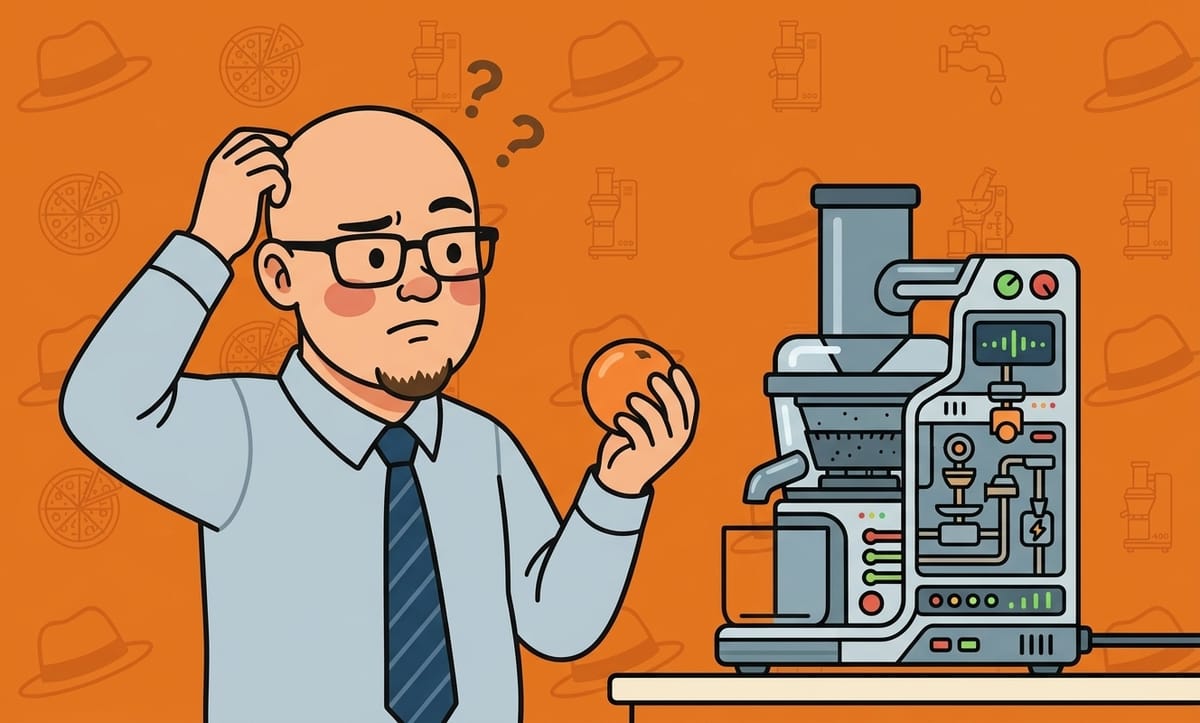
Published under The Flop Hat on HatStacked.com
You do not need a Wi-Fi chip to squeeze a bag of juice. You just need to squeeze the bag.
There is a very specific fantasy that every founder has at 2 a.m., usually after their third espresso and their first "visionary" YouTube video. It goes like this: you identify a mundane, slightly annoying part of daily life, you bolt a sensor and an app onto it, and you get rich fixing a problem that, deep down, was never actually a problem. You call it "innovation." Everyone else calls it "a $400 machine that does the exact same thing your hands already do for free."
Today we are putting on the Flop Hat to talk about Juicero, the most beautiful, most funded, most gloriously unnecessary product failure in recent business history. It is not a story about juice. It is a story about you, your next big idea, and the very expensive lesson you are about to learn the cheap way, if you pay attention.
The Napkin Sketch That Cost $120 Million
Picture the pitch deck. A sleek, countertop appliance about the size of a coffee machine, a connected gadget that promised an internet-of-things device, roughly the size of a Keurig, that juiced vegetables and fruits at the push of a button. You do not chop anything. You do not clean a blade. You slide in a proprietary pouch, the machine scans a QR code to make sure the produce is fresh, and it applies a laughably unnecessary amount of hydraulic force to squeeze out a perfect glass of cold-pressed juice. Silicon Valley did not just like this idea. Silicon Valley threw money at it like it owed the company alimony.
Investors poured roughly $120 million into the company, with big names like Google Ventures and Kleiner Perkins leading the charge. The founder, Doug Evans, was not shy about the scale of his ambition either. Asked to explain why his juice was worth a premium, he offered the kind of quote that should be engraved on a plaque in the Flop Hat lobby: "Not all juice is equal. How do you measure life force? How do you measure chi?"
Nobody in that boardroom asked the one question that actually mattered: "Would a customer just squeeze the bag with their hand instead?" They were too busy measuring chi.
The Machine That Didn't Need to Exist
Here is the part where you start feeling secondhand embarrassment on behalf of an entire venture capital ecosystem. The machine's price started near $700 before eventually settling closer to $400. Nearly $400, plus a subscription for the produce packs, to make a glass of juice you could otherwise make with a blender, a strainer, and roughly ninety seconds of effort.
For a while, this worked, because "for a while" is the natural lifespan of any product that is propped up entirely by hype instead of by a genuine reason to exist. The machine looked cool on a countertop. It photographed well for investors. It even worked, technically, exactly as advertised. The only problem was that "as advertised" was never actually necessary in the first place.
The Bloomberg Squeeze Heard Round the World
Every flop needs its villain origin story, and Juicero's arrived courtesy of a couple of Bloomberg reporters who did something shockingly novel: they tried squeezing the juice pack with their own two hands instead of putting it in the machine.
Bloomberg discovered that customers could get identical results just by squeezing the startup's juice packs with their bare hands, no $400 machine required. Not "close to the same result." Not "almost as good, with slightly less pulp." The same result. The April 2017 report showed the packs could be squeezed by hand in roughly the same amount of time, meaning the huge amount of hydraulic force the machine was built around turned out to be completely unnecessary.
Think about what that means. The single, defining feature of the product, the thing that justified the price tag, the app, the Wi-Fi chip, the QR scanner, the whole reason anyone would ever pull out their credit card, was completely fake. Not fraudulent, exactly. Just... unnecessary. A solution to a problem that human hands had already solved for approximately all of recorded history.
The company tried to recover. It cut the price. It issued refunds. Within a few months, a quarter of the staff had been let go. None of it mattered, because you cannot spin your way out of "my customers just found out they never needed me." Commentators looking back on the wreckage put it plainly: when innovation for its own sake runs amok, you end up with a solution in search of a problem. Within a year and a half of launch, the lights went out for good.
Your Business Doesn't Have $120 Million, But You Have the Same Blind Spot
Here is where you stop laughing at Silicon Valley and start looking uncomfortably in the mirror. You do not have a hydraulic juice press. But you might have the small business equivalent: the "premium" onboarding portal nobody asked for, the custom app you built when a shared spreadsheet would have worked fine, the elaborate loyalty program with tiers and badges when your customers just wanted a punch card and a discount.
Juicero's real mistake was never the hardware. It was falling in love with the solution before confirming anyone actually had the problem. You do this too, just on a smaller budget. You build the feature because it is fun to build, not because a customer asked for it. You add the complexity because complexity feels like progress. You convince yourself that the friction you removed was ever friction worth removing.
The scariest part of the Juicero story is not the $120 million. It is that the company had smart people, real engineers, real market research, and real customers who initially loved the product. Being smart does not protect you from building the wrong thing. It just means you will build the wrong thing more efficiently.
The Hand-Squeeze Test: How to Flop-Proof Your Next Idea
Before you spend another dollar on your next "revolutionary" product, service, or internal process, run it through what we are officially calling the Hand-Squeeze Test. Ask yourself:
- Could a customer just do this themselves, badly but adequately, for free? If yes, your entire value proposition rests on convincing people that "adequately, for free" is somehow worse than "identically, for $400."
- Am I solving a problem, or am I solving my own boredom? Building complicated things is more fun than validating simple ones. That does not make it a good use of your capital.
- Have I actually watched a real customer try to avoid using my solution? Juicero never had a Bloomberg reporter squeeze a bag by hand before launch. You should have someone try to break, skip, or route around your idea before you scale it.
- Would I be embarrassed if a journalist tried the manual version on camera? If the honest answer is "yes, deeply," you have your feedback. Fix it now, while it is still cheap.
None of this requires venture capital. It requires you to be willing to ask an unglamorous question about your own favorite idea, out loud, before you have spent the marketing budget defending it.
The Chi You Don't Need to Measure
You are probably not building a Wi-Fi-connected juicer. But you are, right now, somewhere in your business, measuring chi. You are attaching mystique, complexity, or unnecessary technology to something that was already working just fine with a little elbow grease. The Flop Hat exists to remind you that the market does not care how elegant your solution is. It cares whether the problem was real.
So go squeeze the bag with your bare hands before you build the machine. It will save you $120 million you do not have, and a much more painful lesson you cannot afford to learn twice.