Shadow AI: Your Employees Are Already Feeding Your Secrets to a Chatbot
Your team isn't waiting for permission to use AI, they're already pasting client lists and bank statements into free chatbots to save time. Here's why banning it backfires and what to do instead.

Published under The Technology Hat on HatStacked.com
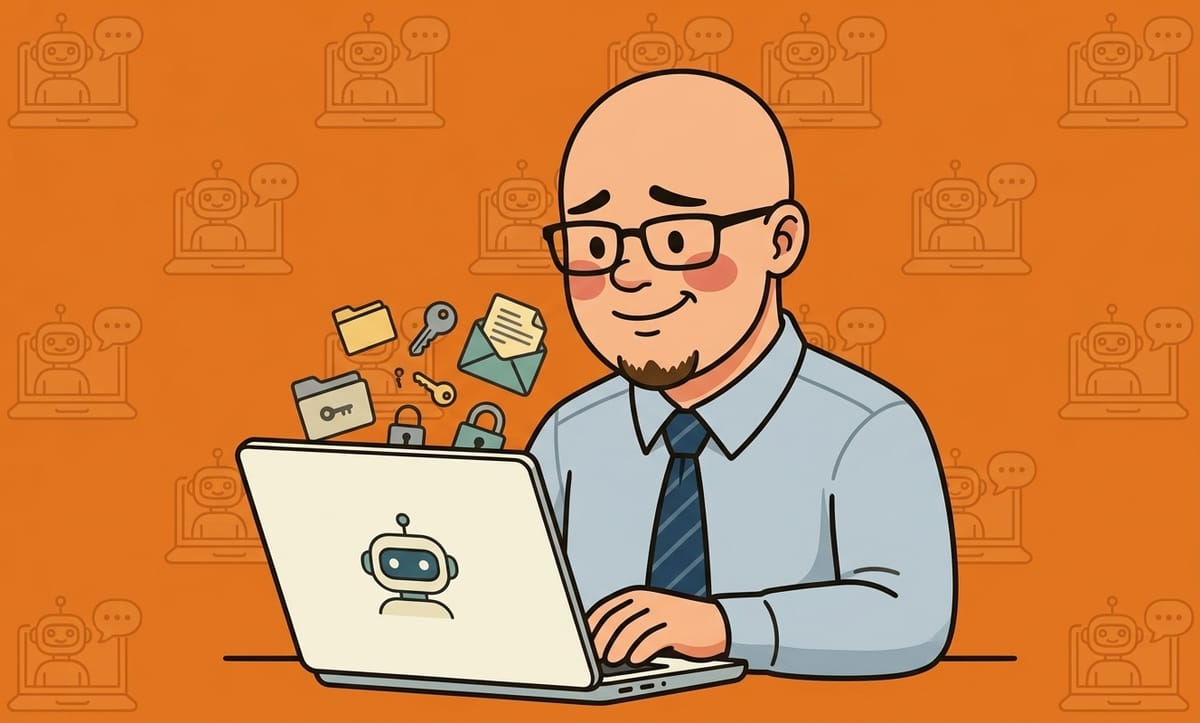
Your newest hire is not stupid. She is efficient. So when her manager asked her to "clean up" the Q3 client list for a mail merge, she did not spend forty-five minutes reformatting it by hand. She pasted three hundred rows of names, emails, and purchase history into a free chatbot and asked it to sort the data by column. It took four seconds. She felt like a genius. You, meanwhile, have no idea this happened, and neither does your client, whose personal information now lives forever in the training logs of a server you will never see.
You didn't get hacked. You got helped. That is somehow worse, because nobody is going to send you a ransom note for it.
The Copy-Paste Economy
Every small business owner is currently living in a fantasy where "our AI policy" means someone in the office occasionally asks ChatGPT to write a LinkedIn post. That is adorable. Meanwhile, your bookkeeper is pasting unredacted bank statements into a free tool to "summarize the month." Your ops manager is uploading vendor contracts to have them "explained in plain English." Your front desk person is copying customer complaint emails into a chatbot to draft a response that sounds less unhinged than their first draft.
None of this shows up on an invoice. There is no line item called "Shadow AI Usage" in your expense report, because nobody billed you for it. Your team just downloaded it, logged in with a personal email, and started working faster. That is the entire problem in one sentence: they got faster, and you got no visibility into how.
This is not a hypothetical. This is happening in your business right now, today, while you are reading this, because free AI tools solve a very real, very human problem: nobody wants to manually reformat a spreadsheet at 4:45 on a Friday. So they find the fastest tool available, and the fastest tool is almost never the one your IT policy (if you even have one) approved.
What Shadow IT Taught Us (And Why Shadow AI Is Worse)
You have lived through a version of this before. It was called Shadow IT, and it was the era of employees signing up for Dropbox and Trello without asking permission because the "official" company tools were clunky and slow. That was annoying. Files ended up scattered across a dozen personal accounts, and when someone quit, you lost access to whatever they had stashed there.
Shadow AI is that same problem, except instead of storing your data somewhere inconvenient, it is actively learning from it. Depending on the tool and its settings, the customer list your employee pasted in might not just sit there. It might get absorbed into a training set, become a data point the model uses to get "smarter" for someone else's query later, or get logged on a server governed by terms of service nobody at your company has ever opened, let alone read.
With Dropbox, the worst case was a leak. With an unmanaged AI tool, the worst case is that your client's personal data, your pricing strategy, or your unreleased product plans quietly become part of the general knowledge soup of a chatbot that a competitor could theoretically query their way into. You do not need to be paranoid about this. You need to be prepared for it, which are two very different postures.
The Three Things Getting Pasted Right Now
If you want to know exactly what is at risk, stop imagining abstract "data" and picture these three categories, because they are the ones that walk out the door first.
Customer PII. Names, emails, phone numbers, addresses, purchase history. Anything your employee thinks of as "just a list" is, legally, a pile of personally identifiable information that you are on the hook for protecting under whatever privacy regulation applies to your state or industry.
Financial documents. Bank statements, payroll files, vendor invoices. These get pasted into AI tools constantly because summarizing a dense PDF is exactly the kind of task chatbots are good at, and exactly the kind of task nobody should be doing with an unvetted, free-tier tool.
Internal strategy. Draft contracts, pricing sheets, HR complaints, the strongly worded email you almost sent to a vendor. Employees use AI to sound more professional, which means they paste in the unprofessional, unfiltered version first. That unfiltered version is the one that ends up somewhere you cannot retrieve it.
Why Banning It Doesn't Work
Your first instinct is going to be a memo. "Effective immediately, the use of AI tools is prohibited." Feel free to send it. It will accomplish exactly nothing, except making your employees better at hiding what they were already doing.
Banning a tool that makes people twice as productive does not make the tool disappear. It just moves the behavior to a personal phone, on a personal account, off any network you could ever audit. You cannot un-invent convenience. The moment your team discovers that a task which used to take an hour now takes ninety seconds, you have lost the ability to simply say no and have that be the end of the conversation.
The businesses getting burned by shadow AI are not the ones with reckless employees. They are the ones with owners who thought "we don't have an AI problem" simply because nobody had told them about it yet.
The Fix: Sanctioned Tools, Not Empty Threats
The goal is not zero AI usage. The goal is zero unmanaged AI usage. There is a real difference, and it comes down to three moves.
Pick an approved tool and pay for it. Free tiers of consumer chatbots are often built around using your inputs to improve their models. Paid business or enterprise tiers of the same tools frequently come with contractual guarantees that your data will not be used for training and will not be retained beyond your session. If your team is going to use AI anyway, the five-dollars-a-seat business plan is the cheapest insurance policy you will buy all year.
Write the rule in one sentence. Not a twelve-page policy nobody reads. Something like: "Never paste a customer's name, financial information, or anything under an NDA into a tool that is not on the approved list." Post it somewhere people actually look, not buried in an employee handbook PDF from 2019.
Make the approved tool the easy option. If the sanctioned tool is harder to log into than the free one your employee already has bookmarked, they will use the free one. Every time. Convenience wins. Make sure convenience is on your side of the ledger.
The Conversation to Have This Week
You do not need a task force. You need one meeting. Ask your team, directly and without judgment, what AI tools they are already using to get their work done. You will learn more about your actual operational bottlenecks in that fifteen-minute conversation than in a year of status reports, because people only reach for a shortcut when the official process is too slow.
Then decide, tool by tool, what gets sanctioned, what gets replaced with a paid version, and what gets a flat "never with customer data" rule. That is the entire framework. It is not glamorous. It will not go viral. But it is the difference between an AI strategy and an AI liability wearing a business's name tag.
Your employees are not the enemy here. They are just doing what efficient people do: finding the fastest tool for the job. Your job is to make sure the fastest tool is also one you are allowed to be proud of when your client asks where their data went.