Do Small Businesses Have to Pay Overtime? The Real Rules (2026 Update)
The "One Big Beautiful Bill" changed the game. Here are the new 2026 salary thresholds and why your employees think overtime is tax-free (and why they are only half-right).


Editor's Note (Jan 2026): This post has been completely updated to reflect the new 2026 Salary Thresholds ($58,656) and the specific tax deduction rules introduced by the "One Big Beautiful Bill Act." If you are reading an older version of this guide elsewhere, burn it. It is wrong.
Disclaimer: I am a business owner, not a labor attorney or a CPA. The "One Big Beautiful Bill" is complex. Do not fire your accountant based on a blog post.
Overtime laws don’t stop at your tiny payroll. Here’s what small businesses really need to know in the era of the "One Big Beautiful Bill."
Small businesses don’t get a “get out of jail free” card just because they only have three employees and a Keurig.
Overtime laws have always been confusing. But in 2026, thanks to the One Big Beautiful Bill Act (OBBBA), they have gone from "confusing" to "front-page news."
Your employees are hearing that overtime is now "tax-free." You are hearing that the salary threshold just went up again. Everyone is confused, and usually, when everyone is confused, the business owner is the one who gets fined.
Here is the no-nonsense guide to who qualifies, who doesn't, and what you actually have to pay.
The "One Big Beautiful Bill" & The "No Tax on Overtime" Myth
Let’s address the elephant in the room first.
In July 2025, the One Big Beautiful Bill Act (OBBBA) was signed into law. It created a temporary federal income tax deduction for overtime pay for tax years 2025–2028.
Your employees probably think this means: "I get all my overtime money tax-free! My paycheck is going to be double!"
The Reality: It is complicated, and you need to explain it to them before they get their first check and riot.
1. It is a Deduction, Not a Bonus
You (the employer) still withhold taxes from their paycheck as normal. The employee gets the money back when they file their taxes in April (starting with the return they are filing right now for 2025).
2. It Only Applies to the "Premium" (The Half)
This is the part everyone misses. The law generally allows them to deduct the premium portion of the overtime (the ".5" in "time and a half").
- Example: Dave earns $20/hour. His overtime rate is $30/hour.
- The "Regular Rate" ($20) is still taxed as normal income.
- The "Premium" ($10) is the part that is deductible.
3. There is a Cap
They can only deduct up to $12,500 (Single) or $25,000 (Married Filing Jointly) of this premium pay per year.
4. High Earners Don't Qualify
If your employee makes over $150,000 (or $300,000 combined household), they get nothing. The benefit phases out completely.
Your Job as the Boss:
You need to report "Qualified Overtime" on their W-2 (Look for Box 12, Code TT). If your payroll software isn't doing this automatically yet, call them. Today.
The Basics: Do You Have to Pay It?
Yes.
The Fair Labor Standards Act (FLSA) sets the baseline: employees who are not exempt must be paid time and a half for every hour over 40 in a workweek.
There is no "Small Business Exemption."
- Enterprise Coverage: If you have $500,000+ in sales, you are covered.
- Individual Coverage: Even if you make less, if your employee handles "interstate commerce" (swiping credit cards, ordering supplies from out of state, sending emails across state lines), they are covered.
Basically: You have to pay it.
Exempt vs. Non-Exempt: The 2026 Thresholds
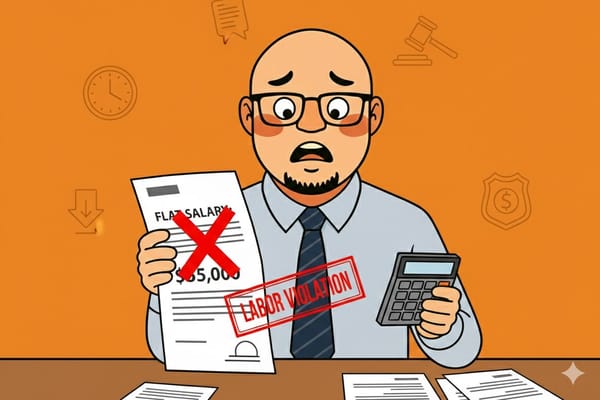
This is where most business owners get sued. You can't just pay someone a salary and say, "No overtime for you." To be Exempt (no overtime), they must meet THREE tests:
- Salary Basis: Paid a set salary that doesn't change based on hours.
- Duties Test: They must be a Manager, an Admin with decision-making power, or a Professional (doctor, lawyer, creative).
- The Salary Threshold (UPDATED for 2026):
As of January 1, 2026, the minimum salary for exemption is $1,128 per week ($58,656 per year).
Read that again.
If you have a "Shift Manager" making $50,000 a year, they are eligible for overtime. You either need to:
- Raise their salary to $58,656+, OR
- Start tracking their hours and paying time-and-a-half.
(Note: Highly Compensated Employees (HCE) now have a threshold of $151,164.)
The "State Law" Trap
The OBBBA is federal. The FLSA is federal. But your state might hate you personally.
- Daily Overtime: States like California require overtime after 8 hours in a day, regardless of the weekly total.
- State Deductions: The OBBBA deduction applies to federal income tax. Your state might still tax that overtime fully.
- Stricter Thresholds: Some states (like NY and CA) have salary thresholds significantly higher than the federal $58,656. Always follow the rule that pays the employee more.
A Real-Life Example (The "Dave" Scenario)
Let’s look at Dave, your lead installer.
- Base Rate: $25/hr.
- Week 1 Hours: 50 hours.
- Overtime: 10 hours at $37.50 ($25 x 1.5).
- Total Pay: $1,000 (Regular) + $375 (OT) = $1,375.
Under the new rules:
You pay him the full $1,375. You withhold taxes on the full $1,375.
However, on his W-2, you flag the premium portion of that overtime.
- Premium = $12.50 (the extra half) x 10 hours = $125.
- That $125 is what goes into the "Tax Free" bucket for his federal deduction.
If you just pay him "straight time" for those 50 hours (a common illegal practice), you are stealing wages, and he can’t claim his tax deduction. You are now the villain twice.
The "Transportation Loophole" (Why Your Driver Might Be Mad)
There is one massive exception in the fine print of the OBBBA that is catching people off guard, specifically in logistics and transportation.
The law says you can only deduct overtime that is "Required under Section 7 of the Fair Labor Standards Act (FLSA)".
Here is the problem: Millions of workers don't get overtime because of the FLSA. They get overtime because of other laws (like the Railway Labor Act) or just because their company is nice.
Who gets screwed by this?
- Airline Pilots & Mechanics: They fall under the Railway Labor Act (RLA), not the FLSA. Their overtime is NOT tax-deductible.
- Railroad Workers: Also RLA. No tax break for them.
- Truck Drivers: Many long-haul drivers fall under the Motor Carrier Exemption. Even if you pay them overtime voluntarily, it is technically "discretionary," not "FLSA Required," so it might not be deductible.
The Takeaway:
If you run a trucking company or a delivery service, check with your CPA immediately. Do not report that overtime as "Qualified" (Code TT) on the W-2 unless you are 100% sure they are covered by the FLSA. If you report it wrong, you are helping them commit tax fraud.
The Bottom Line
The "One Big Beautiful Bill" didn't make overtime cheaper for you. It made overtime more valuable for them.
This is actually a good retention tool. If your team knows that grinding out a 50-hour week comes with a tax break, they might be more willing to do it. But it only works if you track it right, pay it right, and report it right.
Action Items for this Week:
- Audit Salaries: Check anyone making under $58,656. If they are salaried, they are likely misclassified.
- Check Payroll: Ensure your payroll provider is tracking "Qualified Overtime" separately for the new W-2 requirements.
- Stop "Comp Time": Unless you are a government agency, giving "time off next week" instead of paying overtime this week is still generally illegal. Pay the money.
Need more help untangling the 2026 payroll mess? Check out The Great W-9 Hunt or our guide to End-of-Year Tax Prep.