AEO: The Death of the Blue Link
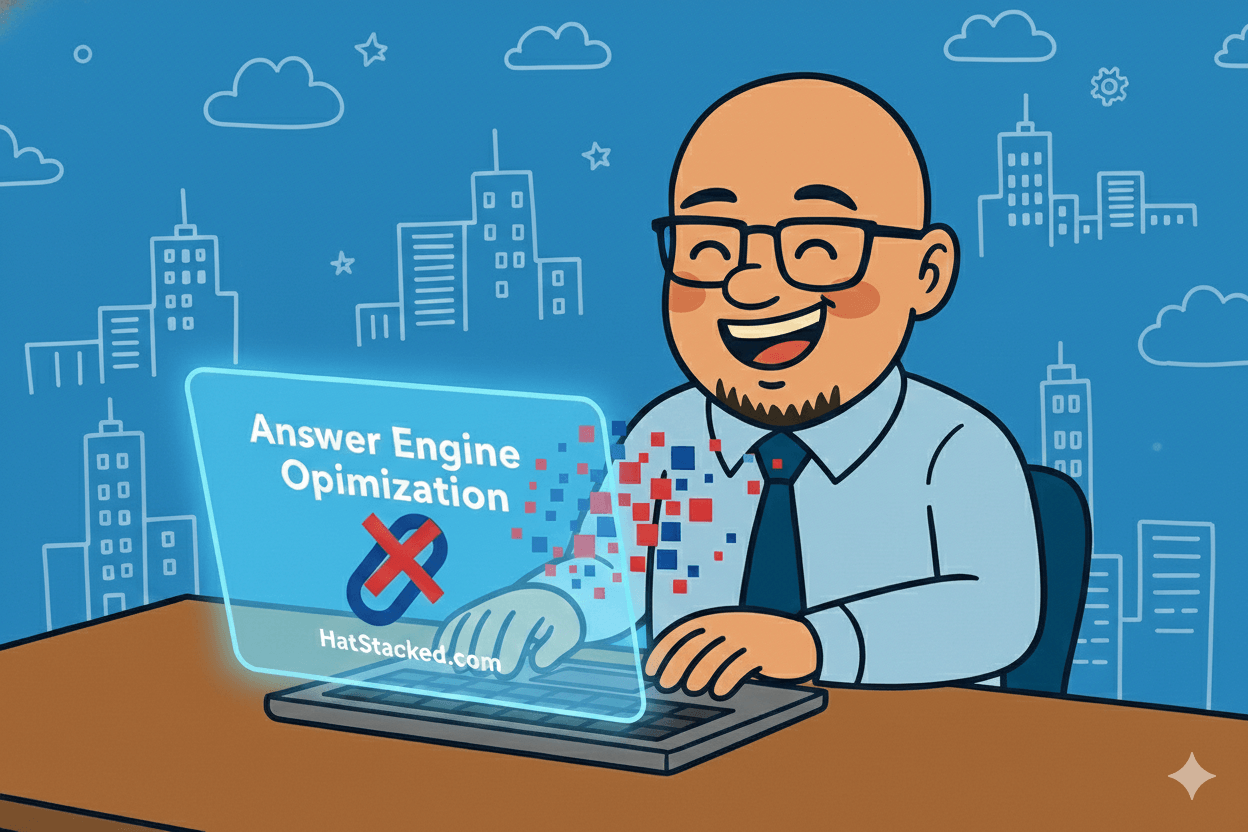
The blue link is dead. In 2026, if your business isn't the "answer" that AI engines provide before the user clicks, you don't exist. Here is the blueprint for surviving the Answer Engine Optimization (AEO) revolution.

I recently spent fifteen minutes trying to find a specific diagnostic code for a scale, only to have a chatbot spit out the exact answer in three seconds while the actual manufacturer's website was still struggling to load its own service manual.
Already subscribed? Skip to the bottom to download the free Google Sheet
The era of the "blue link" is effectively over. If you have been running your small business website based on the search engine optimization rules of 2018, you are currently screaming into a void that no longer exists. For decades, the goal of the internet was to get someone to click a link, land on your page, and hopefully buy something before they got distracted by a cat video. Today, the goal is different: you need to be the answer that the AI provides before the user even thinks about clicking.
Welcome to the world of Answer Engine Optimization (AEO). In 2026, search engines like Google and specialized answer engines like Perplexity or Gemini are no longer acting as librarians pointing you toward a book: they are acting as researchers summarizing the book for you. If your business isn't the one being summarized, you don't exist.
The Zero-Click Reality: A Systemic Shift
We used to track "organic traffic" as the holy grail of digital marketing. If 1,000 people searched for a problem and 100 clicked your link, you were winning. Now, those 1,000 people get the answer directly in the search interface. This is called "zero-click search," and it is eating the traditional web alive. In 2025, data showed that nearly 70% of mobile searches ended without a single click to a third-party website. In 2026, that number is climbing even higher as Large Language Models (LLMs) become the primary interface for the internet.
The panic move for most founders is to try and "trick" the AI into sending traffic anyway. They use hidden text or "AI-proof" wrappers. This is a waste of time. The smart move is to realize that being the cited source for an AI answer is the new version of a premium billboard. You might get fewer clicks to your homepage, but the authority you gain by being the "trusted answer" for a customer's specific, high-intent problem is worth ten times the amount of stray, accidental traffic. When Gemini tells a user, "According to the experts at ScalesPlus, the most common calibration error in industrial load cells is X," that brand impression is worth more than a thousand "top 10" listicle clicks.
From Keywords to Entities: The Semantic Web
Old SEO was obsessed with keywords: "best business scales Michigan" or "how to fix a server." You’d pepper your text with these phrases until it read like it was written by a robot with a head injury. AEO is obsessed with entities and relationships. The AI models of today don't just see words: they see concepts. They know that ScalesPlus is a business, located in Michigan, that handles scales and weighing equipment.
To win at AEO, you have to stop writing for a search bar and start writing for a knowledge graph. A knowledge graph is essentially a giant map of how things relate to each other. If you sell industrial scales, the AI needs to see your site connecting "scales" to "calibration," "ISO standards," "Michigan manufacturing," and "precision logistics." This means your content needs to be structured in a way that clearly defines what you are talking about. You aren't just writing a blog post: you are feeding a database. If you can’t explain your value proposition in a way that a machine can categorize, a human will never see it because the "librarian" won't know which shelf you belong on.
The E-E-A-T Moat: Why Machines Need Humans
AI is incredible at synthesizing information, but it is terrible at having a life. It has never stayed up until 2:00 AM trying to fix a Proxmox server that went down during a firmware update. It has never dealt with a difficult HR situation where the "logical" answer was the wrong human answer. It has certainly never tried to figure out why a scale display keeps flickering like a scene from a horror movie.
This is where your Experience, Expertise, Authoritativeness, and Trustworthiness (E-E-A-T) come in. The only content that will survive the AI purge is content that contains "lived experience." AI can't fake the specific, messy details of running a physical business. When you share those specific stories: the time the warehouse flooded, the specific way you handled a supply chain collapse in 2024, you create a "moat" around your brand that a language model cannot cross. In 2026, "Expert-Led Content" is the only thing that earns a citation in an AI's response. If your content sounds like it could have been written by a bot, the bots will just replace you.
The Architecture of an Answer: Reverse-Engineering LLMs
To optimize for AEO, you have to understand how a model like GPT-4 or Claude 3.5 "reads" your site. They use a process called Retrieval-Augmented Generation (RAG). When a user asks a question, the AI searches a massive index of the web, pulls the most relevant "chunks" of text, and then rewrites them into a coherent answer.
If your content is buried in a five-minute intro about the history of the internet, the RAG process will likely skip you. You need to provide "snackable" chunks of high-density information. This is why we use the "inverted pyramid" of content: lead with the answer, follow with the evidence, and end with the context. If you want to be the one the AI retrieves, you have to make the retrieval process easy. This isn't just about what you say, it's about the technical "findability" of your facts.
Structure is the New Strategy: The Technical Side
If you want to be the answer, you have to format your site for a machine. This means using structured data and schema markup. It sounds like a headache, but it’s essentially just labeling your content so the AI doesn't have to guess. Think of it like a menu: instead of just writing "Hamburger," you are telling the computer: "This is a Product, the price is $10, the ingredients are X, Y, and Z, and 50 people gave it 5 stars."
If you have an FAQ section, it shouldn't just be text: it should be tagged with Schema.org markup so an answer engine knows exactly where the question ends and the answer begins. We are moving away from the "long-form essay" style of the early 2000s and toward a modular, high-clarity style where every paragraph serves a specific purpose. This doesn't mean your writing has to be dry, it just means it has to be organized. If a bot has to hunt for the point of your article, it will find someone else who put the point in the first sentence of an H2 tag.
The Death of Clickbait and the Rise of Directness
The best part of the death of the blue link? The death of clickbait. You can't trick an AI with a "You won't believe what happened next" headline. The AI will just read the article, realize nothing happened, and never cite you again. The "curiosity gap" that powered Buzzfeed and its clones for a decade is officially closed because the AI closes it for the user before they click.
AEO rewards honesty and directness. If your headline promises an answer, your first paragraph better deliver it. We are entering an era where the most boring, clear, and accurate information wins. For those of us actually running businesses and trying to solve problems, that is the best news we’ve had in a decade. It means we can stop playing "marketing games" and go back to being experts. The goal is no longer to get the click, the goal is to be the most reliable node in the network.
The Psychological Pivot: From Searcher to Asker
In the old world, the user was a "searcher." They knew they had to find the information themselves. In the 2026 world, the user is an "asker." They expect the machine to do the heavy lifting. This shift in psychology means that the language people use is changing. Instead of typing "calibration services Grand Rapids," they are saying, "Where can I get a laboratory scale calibrated near me today that is ISO 17025 accredited?"
Your content needs to mirror this conversational, long-tail language. You aren't optimizing for nouns anymore, you are optimizing for intent. What is the asker's actual problem? Are they looking for a price? A process? A location? If you can provide the most direct path from their question to the solution, you win the AEO game.
Building a Semantic Moat: How to Future-Proof Your Brand
A semantic moat is a collection of content so deeply interlinked and authoritative that an AI cannot talk about your industry without mentioning you. You build this by creating "pillar" content that covers every facet of a specific topic. If you are the expert on small business operations, you don't just write one post, you write the definitive guide on everything from payroll to shipping.
You want the AI to see your site as a "Cluster of Authority." When the AI sees that you have 50 articles all interlinked about industrial weighing technology, and those articles all cite primary data or personal experience, it assigns you a high "Authoritative Score." In the 2026 landscape, being an "all-rounder" is a recipe for invisibility. You have to pick your lane and own the semantic space within it.
How to Audit Your Site for AEO
So, how do you actually do this? You start with an intent audit. Look at your top-performing pages and ask: "If a user asked an AI for this information, would my page be the easiest one to summarize?"
- The Lead Sentence Rule: Every section (H2) should start with a 25-30 word summary that answers the question posed in the header. This is the "snippet" the AI will grab.
- Table Everything: AI models love tables. If you are comparing products or listing specifications, put them in a table. It is the highest-value data structure for a machine.
- Bullet Point Precision: Use lists for processes. A "How-To" guide that is a wall of text will be ignored. A "How-To" guide with 6 clear steps will be converted into a "Step-by-Step" guide in the search results.
- Internal Entity Linking: Don't just link to other pages, link related concepts. Show the AI how your different areas of expertise connect.
- Natural Language Headers: Use questions as your H2s and H3s. People ask questions, search engines provide answers. Align your site structure with that flow.
Adapt or Vanish: The 2026 Mandate
The blue link was a good run, but it was always a middleman. The goal of technology has always been to reduce friction, and clicking a link is friction. Waiting for a page to load is friction. Declining 45 different cookie consents just to read a blog post is massive friction. The AI bypasses all of it to give the user what they actually wanted: the information.
Your job as a founder or a business owner is to make sure that when the friction is gone, your expertise is what remains. Stop counting clicks and start counting citations. In the new economy, attention isn't measured in page views, it's measured in being the "default" answer. If the bots think you’re the expert, the humans will eventually follow. The blue link might be dead, but the need for real, human expertise has never been higher.
 Related: AI in Operations: Turning 8-Hour Processes Into 8-Minute Tasks
Thanks for subscribing! Here is the audit checklist as promised. Click the link below to save a copy to your own Google Drive.